If Cursor pulled it off (we'll know soon in production) this is a major win for application layer companies (and loss for foundation models). #(Cool) Dev
"Three months ago, the consensus was that Cursor was cooked.
Claude Code crossed $2.5B in run-rate revenue. Google paid $2.4B for Windsurf’s IP and poached its leadership into DeepMind. OpenAI acquired Astral, the team behind Python’s uv package manager, to feed Codex. Viral tweets were circulating about developers ditching Cursor for Claude Code. The usage-based pricing switch last July had users posting surprise bills on Reddit. Consumer subscriptions were running at negative margins because every token served was profit for Anthropic or OpenAI.
The company that popularized vibe coding was getting buried by the model providers it depended on.
Then Cursor shipped four major releases in 15 days. JetBrains support on March 4. Automations on March 5. Plugin marketplace with 30+ partners on March 11. And now Composer 2, their own model that moggs Opus 4.6 on cost while matching it on performance.
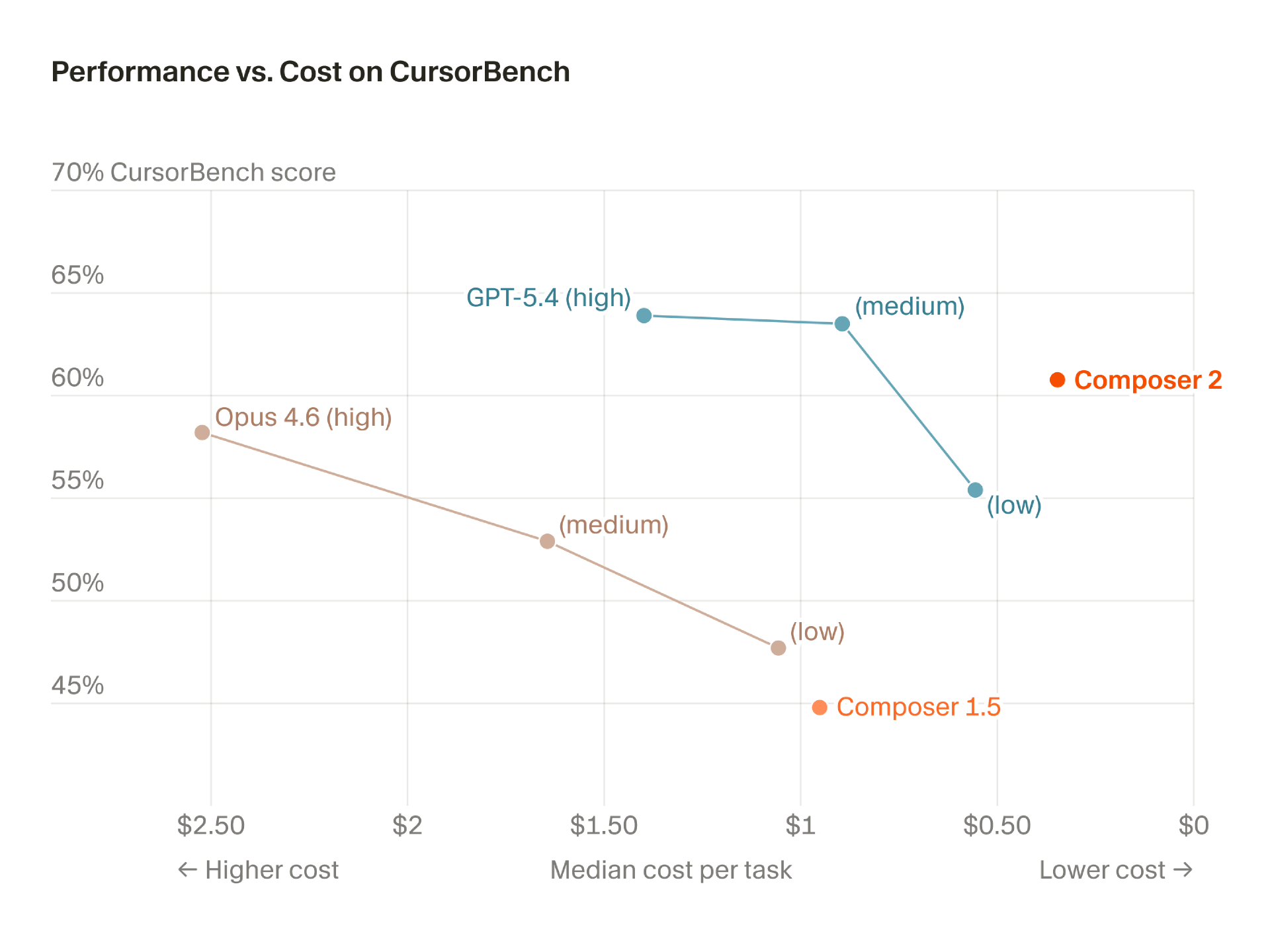
Look at the chart. Composer 2: 61.3 on CursorBench at $0.50 per million input tokens. Opus 4.6: 58.2 at $5.00. GPT-5.4: 63.9 at $2.50. The performance gaps are single digits. The cost gap between Composer and Opus is 10x.
The part nobody’s pressing on: Cursor still won’t name the base model. Their blog says “our first continued pretraining run,” which means they took an existing model and continued training on code. When the original Composer launched in October, developers kept catching it responding in Chinese. Same tokenizer patterns as DeepSeek. Nathan Lambert congratulated the research team by tweeting “open weight base models + incredible ML teams in a specific niche can create immense value.” Co-founder Aman Sanger told Bloomberg it was trained exclusively on code. Can’t do taxes, can’t write poems.
A Chinese open-source chassis, refined with what Cursor calls compaction-in-the-loop RL, and fed by a billion lines of daily user code flowing through the editor every day. That data flywheel is the one asset no API provider can replicate.
The honest read requires some skepticism though. CursorBench is Cursor’s own internal benchmark. They built the test, then showed you they pass it. GPT-5.4 still leads on Terminal-Bench 2.0, which is independently maintained. And Opus 4.6 at high thinking effort still outscores Composer 2 on raw accuracy. The cost advantage is real. The performance parity claim needs external validation before anyone should take this chart at face value.
But here’s why the chart matters anyway. This was the P0 coming out of the holidays. Building their own model was existential. Every dollar Cursor paid Anthropic per token was margin funding the competitor building Claude Code to replace them. Every dollar paid to OpenAI funded Codex. The only way to stop bleeding cash to the companies trying to kill you is to stop using their models.
Four hundred employees. $2B ARR. Reportedly raising at $50B. Entering the model race against labs with thousands of researchers and tens of billions in compute.
That chart is the fundraising slide. Whether it holds up in production against Opus and GPT-5.4 is a different question. But three months ago, the question was whether Cursor would survive at all."
h/t Aakash Gupta (@aakashgupta on X)
https://cursor.com/blog/c..
#Data is beautiful